How to Identify Real Cashmere: Burn Test, Microscopy & Hand Feel Explained

How to Identify Real Cashmere: Burn Test, Microscopy, and Hand Feel Explained
Introduction
A scarf labeled "100% Cashmere" carries no legal guarantee that the fiber inside matches the claim. Entrupy's 2026 State of the Fake report, which analyzed $3.7 billion in luxury goods, found that 8.1% of items could not be authenticated, and within the apparel category specifically, counterfeit rates reached 35%. In the unregulated corners of online marketplaces, researchers estimate that up to 60% of products sold as cashmere contain significant quantities of cheaper fiber.
Three identification methods separate genuine cashmere from its impostors. Each reads a different physical signal. The burn test identifies protein fiber versus synthetic. Microscopy reads scale structure. Hand feel registers fiber diameter and friction. None works perfectly alone. Combined, they form a cross-verification sequence that catches the vast majority of counterfeit cashmere on the market.
This article covers the science behind each method, not marketing shortcuts. If you have read our Knitting Basics guide, you already understand why fiber-level analysis matters: the raw material determines everything downstream, from yarn spinning behavior to final fabric performance.
Method 1: The Burn Test — Reading Protein Chemistry
The burn test is the oldest fiber identification method in textiles, and it works on a simple biochemical principle. Cashmere is a protein fiber composed primarily of keratin, the same structural protein found in human hair, fingernails, and animal horn. When you apply heat to keratin, it undergoes thermal decomposition through a predictable sequence: denaturation, pyrolysis, and finally carbonization.
Synthetic fibers behave entirely differently under heat. Acrylic, the most common cashmere substitute, is a petroleum-derived polymer. Under flame, it melts, then burns. The chemical difference between keratin and polyacrylonitrile produces three distinct signals: combustion behavior, smoke character, and residue morphology.
How to Perform the Burn Test
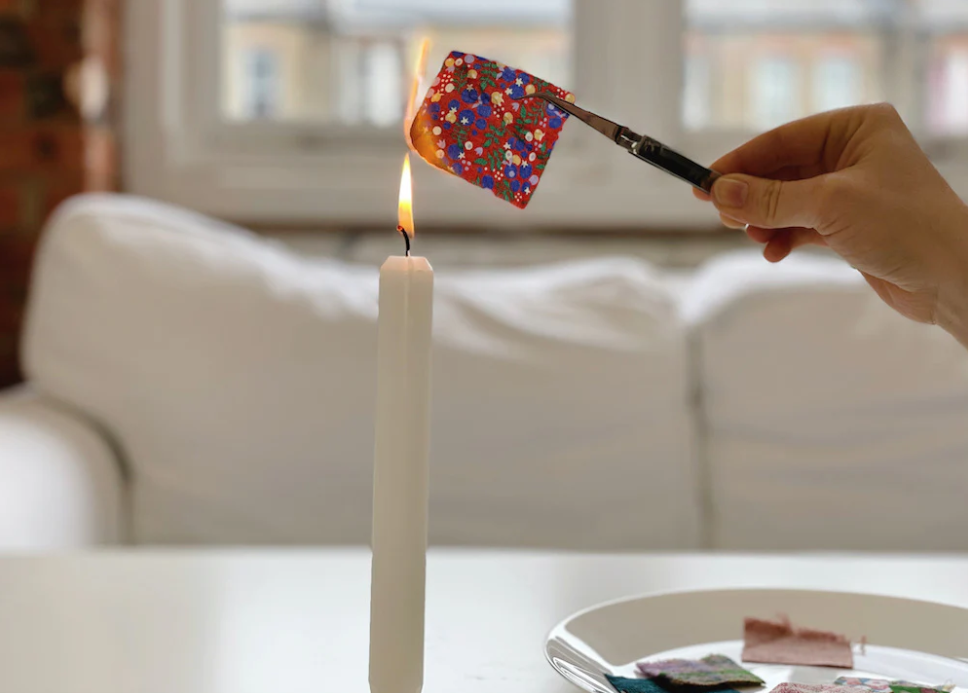
Take a small fiber sample from an inconspicuous area — an inner seam or a loose thread inside the fringe is ideal. A tuft 3–5 mm across is sufficient. Hold it with metal tweezers. Do not use plastic tweezers, which will melt and contaminate the sample.
Bring the fiber close to the edge of a flame. Do not plunge it directly into the fire; let the flame tip make contact. Observe four things in sequence:
- What happens as the fiber approaches the flame
- How it burns once ignited
- Whether it continues burning after you remove the flame
- The residue left behind
Reading the Results
Genuine cashmere (and all wool): The fiber curls away from the approaching flame, then ignites slowly. It burns with a small, flickering flame and produces minimal white or light gray smoke. The moment you remove the flame, it self-extinguishes. The odor is unmistakable: burning hair or singed feathers, caused by sulfur compounds released during keratin decomposition. The residue is a black, brittle ash that crumbles to powder between your fingers.
Acrylic (the most prevalent fake): The fiber melts and shrinks back before it even touches the flame. Once ignited, it burns rapidly with a bright, sooty flame and thick black smoke. When the flame is removed, it keeps burning. The odor is acrid and chemical, like burning plastic. The residue is a hard, black, irregular bead that cannot be crushed.
Polyester blends: Similar to acrylic, polyester melts and drips away from the flame. It burns with a sweet, chemical smell and leaves a hard, round, dark bead.
Viscose/rayon: These cellulose-based fibers burn like paper, with a bright, fast flame and a smell of burning wood. The ash is soft and gray. No bead forms.
Why the Burn Test Alone Is Not Enough
The burn test answers one question: protein fiber or synthetic? It cannot distinguish cashmere from sheep's wool, alpaca, or mohair. All animal fibers are keratin-based and share nearly identical combustion characteristics. If you test a scarf and it passes the burn test, you have eliminated acrylic and polyester counterfeits. You have not yet confirmed it is cashmere.
For that, you need microscopy. If you are sourcing cashmere scarves and need to evaluate fiber content across a batch, our Quality Guide walks through the sampling methodology that professional buyers use.

Method 2: Microscopy — The Scale Structure Fingerprint
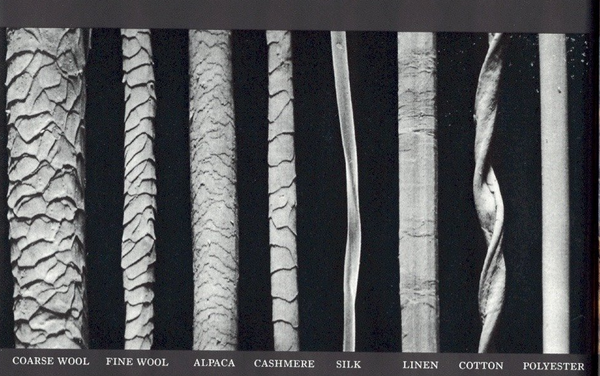
Under a microscope, animal fibers reveal a diagnostic feature: their outer surface is covered in overlapping scales, much like roof tiles or fish scales. This is the cuticle layer, and its morphology varies systematically between species. Cashmere scales differ from wool scales in three measurable ways: spacing, edge morphology, and degree of protrusion from the fiber shaft.
A basic handheld microscope with 200x magnification is sufficient for fiber identification. Laboratory-grade analysis uses scanning electron microscopy, but a consumer-level digital microscope connected to a laptop produces images clear enough to distinguish cashmere from wool in under a minute.
Cashmere Scale Characteristics
Cashmere fiber scales are arranged in a ring-like pattern around the fiber shaft. They sit flat, with edges that lie close to the fiber surface rather than protruding outward. The scale spacing is relatively wide, with longer gaps between successive scale edges. Under 200x magnification, a cashmere fiber looks smooth and cylindrical, with faint, widely-spaced horizontal lines marking the scale boundaries.
This smooth surface architecture is the physical reason cashmere feels soft. The scale edges do not catch on skin or on adjacent fibers. The fiber glides.
Wool Scale Characteristics
Sheep's wool scales are densely packed along the fiber. Unlike cashmere, the scale edges protrude outward, creating a serrated profile. Under the microscope, wool looks like a stack of overlapping roof tiles with visible gaps between each layer.
These protruding edges are the mechanical cause of the "prickle" sensation associated with wool. When a wool fiber presses against human skin, individual scale edges trigger mechanoreceptors in the epidermis. The lower the fiber diameter, the less pronounced this effect, which is why superfine merino wool (under 18 microns) can feel almost as soft as cashmere even though its scale morphology is technically different.
The Superfine Merino Overlap Problem
There is one genuine diagnostic challenge. Superfine merino wool with fiber diameters below 17 microns can have scale structures that approach the smoothness of lower-grade cashmere, particularly Grade C cashmere in the 18–19 micron range. In these edge cases, fiber diameter measurement becomes essential: cashmere averages 14–19 microns, while merino wool averages 17–24 microns. A fiber at 15 microns with smooth scales is almost certainly cashmere. A fiber at 20 microns with smooth scales requires further investigation.
Chemically stripped wool adds another complication. Some manufacturers use chlorine-based treatments to remove the scale layer from wool fibers, a process known as descaling or chlorination. The result simulates cashmere's smoothness but destroys the very diagnostic feature microscopy relies on. In these cases, the burn test still works (protein fiber is confirmed), but the fiber type cannot be visually identified.
For more on fiber diameter and the yarn count systems used in knitwear, see our Yarn Count (Nm) Explained article.

Method 3: Hand Feel — The Physics of Tactile Perception
Hand feel is often dismissed as subjective, but it is grounded in measurable physics. Human fingertips can detect surface irregularities at the micron scale through two mechanisms: fiber diameter relative to the tactile threshold, and surface friction coefficient.
The Tactile Threshold
Research on tactile perception establishes that the smallest surface irregularity a human fingertip can detect is approximately 20–25 microns. Cashmere fibers range from 14–19 microns in diameter, sitting comfortably below this threshold. When you run your fingers across a cashmere surface, you are not feeling individual fibers. You are feeling a continuous, smooth surface.
Standard sheep's wool fibers range from 25–40 microns. These exceed the tactile threshold. Your fingertip registers individual fibers, and your brain interprets each one as a micro-irritation. This is the neurophysiological basis of the "scratchy" or "prickly" sensation.
Surface Friction Coefficient
The second variable is friction. Cashmere's flat-lying scales create a low-friction surface. Wool's protruding scales generate higher friction against skin. Multiply this effect across thousands of fiber tips making contact with a fingertip, and the difference is perceptually dramatic.
Why Hand Feel Can Deceive
Textile finishing chemistry can manipulate both of these variables. Silicone-based softeners coat fibers with a lubricating film that reduces surface friction, making polyester feel like cashmere. Brushing and raising techniques create a nap of short fibers on the surface, disrupting the tactile signal from the underlying base fiber.
Hand feel is a useful confirmation signal, never a standalone diagnostic. A scarf that feels rough is unlikely to be high-grade cashmere. A scarf that feels soft may be anything: cashmere, treated wool, or silicone-coated acrylic. Our Pilling Guide explains how these surface treatments degrade over time and why initial hand feel can be deceptive.
The Three-Step Cross-Verification Protocol
No single method is definitive. Combined, they eliminate nearly all counterfeits:
| Step | Method | What It Rules Out |
|---|---|---|
| 1 | Burn test | Synthetic fibers (acrylic, polyester, nylon) |
| 2 | Microscopy | Sheep's wool, alpaca, mohair |
| 3 | Hand feel | Confirms fiber grade consistency with Steps 1–2 |
Step 1 catches the most common fraud: acrylic sold as cashmere. Step 2 catches the second-most common: wool labeled as cashmere. Step 3 provides a consistency check. If the fiber passes Steps 1 and 2 but feels unusually coarse, the cashmere is likely low-grade (Grade C, 18–19 microns), which is genuine but not what most consumers expect at a premium price point.
If you are evaluating a bulk purchase or working with a new supplier, apply this protocol to a random sample from the shipment. For detailed guidance on supplier verification, our Factory Audit Checklist provides the full framework.
Technical references: ISO 17751-1:2023 (Quantitative analysis of cashmere, wool, other specialty animal fibres and their blends); IWTO-58 (Test Method for Fiber Diameter of Cashmere); U.S. Wool Products Labeling Act of 1939.
Looking for verified cashmere scarf suppliers? Source scarves directly from Weave Essence.
Want to see more? Explore the online showroom.
Read more
Cashmere Scarf Origin Tariffs: China vs. Mongolia vs. Italy — HS Codes and Duty Rates Compared
Cashmere Scarf Origin Tariffs: China vs. Mongolia vs. Italy Compared Introduction Two identical cashmere scarves, same fiber grade, same weight, same construction. One lands from China. One lands from Mongolia. The duty bill differs by thousands of dollars per shipment. The origin label on the box, not the fiber inside

2026 Section 301 Scarf Tariffs: Current Rates, Hearing Updates, and Supply Chain Impact
2026 Section 301 Scarf Tariffs: Current Rates, Hearing Updates, and Supply Chain Impact Introduction A scarf landed from China into the United States in May 2026 does not pay a single tariff rate. It pays three. A baseline most-favored-nation (MFN) rate, a Section 301 surcharge from the original Trump-era trade
Scarf Fiber Warmth-to-Weight Ratio: Cashmere vs. Merino vs. Alpaca vs. Acrylic
Scarf Fiber Warmth-to-Weight Ratio: Cashmere, Merino, Alpaca, and Acrylic Compared Introduction Warmth is the primary functional promise of any winter scarf. Yet "warmth" is rarely defined in measurable terms when fibers are compared. A scarf is not warm in the abstract. It is warm at a given weight,
Why "100% Cashmere" Labels Lie: Blend Ratio Detection Explained
Why "100% Cashmere" Labels Lie: Blend Ratio Detection Explained Introduction A label that reads "100% Cashmere" is not a certificate. It is a claim, and claims in the cashmere supply chain are routinely false. Independent market surveys estimate that 30-60% of products sold as "100%